Things are now at a dead stop. Techshop declared bankruptcy today and closed its doors.
I should have been clear, in hind sight that this was going to happen - for the last few months the equipment hasn't been repaired or well maintained. The dust extraction was dismantled a few months ago and never replaced.
It's not clear how I can proceed since the design depends on the precision cutting of the braces, frankly not very easy (and not intended to be done) by hand.
That's half the $1,000 membership down the drain. By the time I'm finished I could have bought a pair of speakers for less.
Wednesday, November 15, 2017

Sunday, October 1, 2017
Second iteration for the matrix bracing
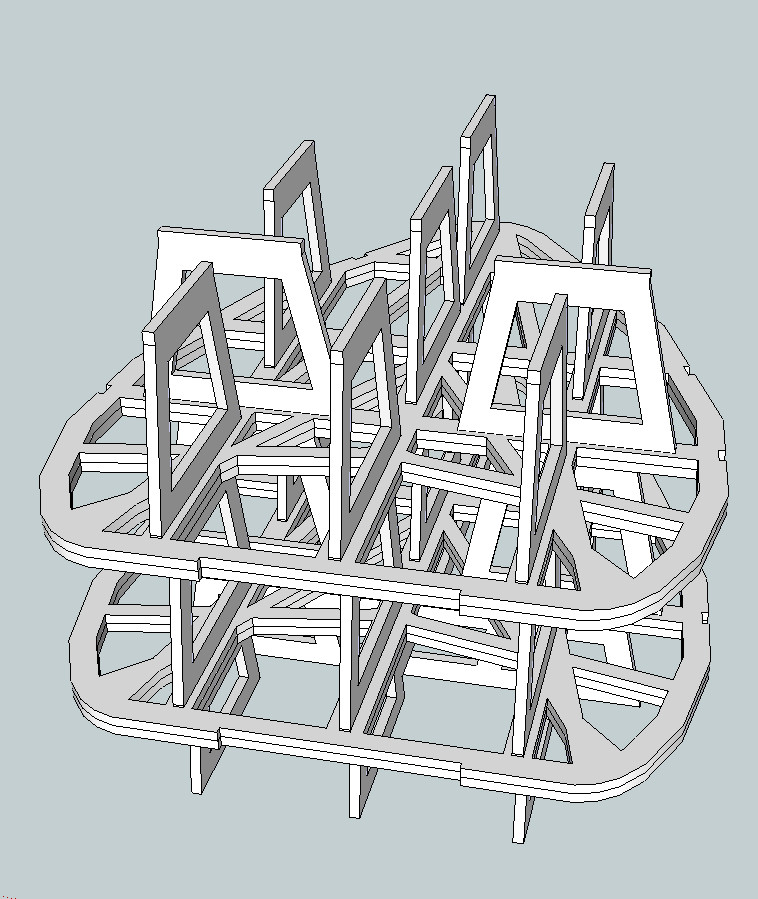
Each horizontal brace is now made from two sheets of 1/4 inch ply. The slots for the vertical spacers are cut completely through so that each spacer sits directly on top of the one below. This idea is to make sure that the drawing's dimensions are absolutely adhered to and don't depend on the thickness of the plywood which is quite variable. Moving to this two layer brace sandwich also afforded the opportunity to add additional vertical spacers at the front.


The spacers are rather 'bendy' when the vertical axis lies across the grain, but stiffer when it is with the grain. Although the spacers are not load-bearing, I think for the remaining cuts I will ensure that they are all vertical.
This build is turning out to be much more complicated and time-consuming than the Phase-IVs. Partly that's a function of getting to grips with the Shopbot, and one false start, but Phase-IVs had very little assembly. These by contrast have orders of magnitude more; and I'm not even close to starting on the cabinet walls yet.


The spacers are rather 'bendy' when the vertical axis lies across the grain, but stiffer when it is with the grain. Although the spacers are not load-bearing, I think for the remaining cuts I will ensure that they are all vertical.
This build is turning out to be much more complicated and time-consuming than the Phase-IVs. Partly that's a function of getting to grips with the Shopbot, and one false start, but Phase-IVs had very little assembly. These by contrast have orders of magnitude more; and I'm not even close to starting on the cabinet walls yet.
Saturday, May 13, 2017
Matrix-like interior bracing

Wednesday, June 8, 2016
The cutting begins!
After weeks of practicing turning the Sketchup designs into tool paths using the trial version ov VCarve pro, I finally started cutting the wood. Although the design may have to be tweaked as I learn more about using the Shopbot, the first session was more productive than I expected. I cut all the matrix bracing stays (vertical separators) and did an experimental cut (one that after a few minutes was clearly wasn't going to work).
The laminate panel (chipboard and 1/4" finished plywood looks like it worked much better than I had anticipated. The rolling on the the glow and lots of clamps seems to have done the trick. The only issue is a gentle warp which makes cutting difficult as the sheet has to be very firmly secured to the sacrificial board. And there is a tendency to break though the tabs if there aren't enough of them.
These two videos show the Shopbot in action. It is remarkable to see the finished pieces taking shape. It's as if, after staring at them for months on the screen in the CAD program, they were being slowly beamed1 down from the virtual world of Sketchup.
What was also gratifying was that the toolpaths worked exactly as envisioned. Of course that was perhaps a little less surprising since VCarve has a very sophisticated preview for exactly that purpose.
(Note the passage of time - the first was show at about 3pm, the second at about 6pm. Some of that was testing and altering tool paths, but the cutting does take some time).
The only remaining question is the 45 degree cut at the top of each panel. Since they are still fairly firmly attached to each other, I might try using the router here....
1 Gratuitous Star Trek reference
The laminate panel (chipboard and 1/4" finished plywood looks like it worked much better than I had anticipated. The rolling on the the glow and lots of clamps seems to have done the trick. The only issue is a gentle warp which makes cutting difficult as the sheet has to be very firmly secured to the sacrificial board. And there is a tendency to break though the tabs if there aren't enough of them.
These two videos show the Shopbot in action. It is remarkable to see the finished pieces taking shape. It's as if, after staring at them for months on the screen in the CAD program, they were being slowly beamed1 down from the virtual world of Sketchup.
What was also gratifying was that the toolpaths worked exactly as envisioned. Of course that was perhaps a little less surprising since VCarve has a very sophisticated preview for exactly that purpose.
(Note the passage of time - the first was show at about 3pm, the second at about 6pm. Some of that was testing and altering tool paths, but the cutting does take some time).
The only remaining question is the 45 degree cut at the top of each panel. Since they are still fairly firmly attached to each other, I might try using the router here....
1 Gratuitous Star Trek reference
Friday, May 20, 2016
Waming up
Thais may be a trick of the mind but the bass response seems to get better after about an hour's continuous use. I wonder whether the rubber suspension is cold and stiff but as the bass driver imparts energy to it, it warns up and becomes more supple?
If so, I need to ensure that I calibrate all the drivers after playing music through them for a significant period at the kind of volume I intend to listen at.
If so, I need to ensure that I calibrate all the drivers after playing music through them for a significant period at the kind of volume I intend to listen at.
Saturday, March 26, 2016
Pick up the thread
August 10, 2011 - that's when I finished building the Phase IVs - was 1690 days (or 4 year 7 months) ago. But today I took the first concrete steps in the next phase; I bought some of the wood I need for the Phase Vs.
The woofers AC 250F1s I've had for 4 years. I was going to use Hiquphon OW1 tweeters but at $250 a pair I decided instead to go with the Vifa D27TG-45-06s, the same ones I used in the Phase IVs since I bought 6 of them during the last build (not sure why).
I had been thinking about the AC 130F1 for the mid driver but they didn't seem, on paper anyway, much better than the Scan Speak 15m-4624 I already have (from the MkIII project). First, it's cheaper to get a second Scan Speak than two AC130s and the Scan Speak has a circular chassis which makes routing it into the baffle much easier.
So what was once going to be a no-compromise final build has turned into a more incremental evolution (though I know it will probably be the last iteration).
I'm experimenting with panels made of plywood glued to fiberboard. I need to figure out how not to damage the veneer on the panels while I'm building the enclosures. Other than that next weekend it's off to the races.
The woofers AC 250F1s I've had for 4 years. I was going to use Hiquphon OW1 tweeters but at $250 a pair I decided instead to go with the Vifa D27TG-45-06s, the same ones I used in the Phase IVs since I bought 6 of them during the last build (not sure why).
I had been thinking about the AC 130F1 for the mid driver but they didn't seem, on paper anyway, much better than the Scan Speak 15m-4624 I already have (from the MkIII project). First, it's cheaper to get a second Scan Speak than two AC130s and the Scan Speak has a circular chassis which makes routing it into the baffle much easier.
So what was once going to be a no-compromise final build has turned into a more incremental evolution (though I know it will probably be the last iteration).
I'm experimenting with panels made of plywood glued to fiberboard. I need to figure out how not to damage the veneer on the panels while I'm building the enclosures. Other than that next weekend it's off to the races.
Tuesday, March 1, 2016
About time
It's about time I started work on the Phase Vs. I have an all-wood design completed, and an idea for how I will build them; I just need to buy the wood (and the tweeters) and make a start...
Saturday, June 21, 2014
One year on
Just realized it's a bit over a year since I replaced the SUV-6; and I still haven't remeasured the speakers, let alone redesigned the crossovers.
Friday, June 14, 2013
Out with the old, in with the new
My first amplifier I bought in 1979, a Technics SUV-6. I'd saved up for a set of B&W DM7s eventually decided to get a second hand pair of DM6s. So then I needed an amp. Mr Robinson, the Bowers & Wilkins salesman (the retail shop was I think already a separate business from the speaker division by then) suggested the SUV-6 and so that's how I ended up with it - along with a Technics SL150 turntable and an SME 3009 Series II tonearm. The only other change in my setup until this week was a Linn (ex demo from Grahams HiFi in Camden) with an Ittok which replaced the SL150+SME in 1987.
 That is until last week, when my trusty SUV-6 finally gave up the ghost. It's fixable I think but the input switch has been getting more and more temperamental for several years and last week it decided to stop working altogether.
Knowing I wasn't going to have time to fix it for a while, I decided to take the plunge and buy a new amp. I did some estimates and figured for the GBP 200 I paid in 1979, with inflation and the exchange rate, I should be spending between $1,200 and $1,600.
So instead I looked for the cheapest reasonably well reviewed integrated solid state amp I could find. And so plumped for this (bottom of the pile in the pic), the Yamaha A-S500, a B-stock factory reconditioned unit for $319. And I was in for a bit of a surprise.
I had always rather poo-poohed the notion that amps could really do much to alter the sound. After all it's simple a case of taking a signal and making it louder. The scope for 'error' was far lower than in the engineering of a turntable or a cartridge. And speakers, clearly have a huge impact.
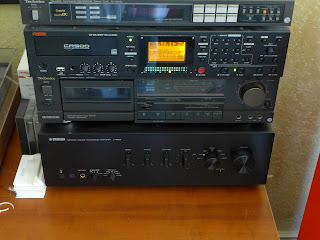 And was I wrong! The A-S500 is rated as 85W into 4 ohms, compared to SUV-6's 70W, but it's much wimpier. But that's only the beginning. It's completely lacking in bass compared to the SUV-6. On my Phase IV's there's almost nothing there below about 150Hz. The 31Hz open B notes in Becker's "11 Track of Whack"? The bass player appears to have taken the day off.
But suddenly the DM6s sound a bit more like a modern speaker - brighter and without the smiley face response curve. I haven't done any tests yet, but I suspect the new amp has flattened out the DM6 curve.
And that's is a bit of a problem since it suggest that the SUV-6 was as much a part of the smiley face as the speakers - and I used it do calibrate the Phase IVs and build the crossovers. Ugh!
On the plus side, I can always go back to individual driver testing and redesign the crossovers; which I will undoubtedly have to do if I want to continue to use them with the A-S500. But if I repair the SUV-6 then I'll need the current crossovers. Not to mention that I am still thinking of getting a cheap tube amp at some point, and it's not clear how that will change the picture. And of course I've got the Phase Vs on the drawing board which I'll start building when...
I may have to build external crossovers that are matched to a speaker amplifier pairing.
Damn! Lots of work, lots of variables, not enough time (or money).

Knowing I wasn't going to have time to fix it for a while, I decided to take the plunge and buy a new amp. I did some estimates and figured for the GBP 200 I paid in 1979, with inflation and the exchange rate, I should be spending between $1,200 and $1,600.
So instead I looked for the cheapest reasonably well reviewed integrated solid state amp I could find. And so plumped for this (bottom of the pile in the pic), the Yamaha A-S500, a B-stock factory reconditioned unit for $319. And I was in for a bit of a surprise.
I had always rather poo-poohed the notion that amps could really do much to alter the sound. After all it's simple a case of taking a signal and making it louder. The scope for 'error' was far lower than in the engineering of a turntable or a cartridge. And speakers, clearly have a huge impact.

But suddenly the DM6s sound a bit more like a modern speaker - brighter and without the smiley face response curve. I haven't done any tests yet, but I suspect the new amp has flattened out the DM6 curve.
And that's is a bit of a problem since it suggest that the SUV-6 was as much a part of the smiley face as the speakers - and I used it do calibrate the Phase IVs and build the crossovers. Ugh!
On the plus side, I can always go back to individual driver testing and redesign the crossovers; which I will undoubtedly have to do if I want to continue to use them with the A-S500. But if I repair the SUV-6 then I'll need the current crossovers. Not to mention that I am still thinking of getting a cheap tube amp at some point, and it's not clear how that will change the picture. And of course I've got the Phase Vs on the drawing board which I'll start building when...
I may have to build external crossovers that are matched to a speaker amplifier pairing.
Damn! Lots of work, lots of variables, not enough time (or money).
Friday, November 23, 2012
As low as it gets

How deep?
Well, the plot on the left, generated in Audacity, shows that on track #4, "Bright Nightgown", the fundamental of the bass note is at about 34Hz. The open E on a bass guitar is 41Hz, and the open B on a 5 string comes in a 31Hz. For what it's worth, 34.65Hz is a C#.
Since the Phase IV Mk2s don't really render much below about 60Hz, the reproduction of this note depends almost exclusively on the harmonics (of which fortunately there are several). This low note in "Bright Nightgown" is almost an octave (10 semitones) below what the Phase IV Mk2s can reproduce!

All of which has got me wondering how different would the sound be with drivers that could really generate those low frequencies.

Which turns out to be just as well. We shall see...
Thursday, October 27, 2011
Why Phase IV?
Just before going to college (1979) Graham, who worked at B&W, sold me a couple of 801 bass drivers. Phase I used these (they were really wonderful units) with Kef B110bs for the mid range and DM7 stand alone tweeters. The crossovers were stock 3-way units that crossed at 200 and 4k (at least as far as I can recall). I have no pictures of the Phase Is.
Phase II was a rebuild of the Phase I cabinet but used the same drivers and crossover. The result was fairly unsuccessful since I limited the bass response by making the air volume too small. Again, no pics.
Phase III was the intervening 30 years.
Phase IV was my attempt to build speakers using much cheaper drivers (my father, bless him, threw out the 801 drivers when he was cleaning out his attic in 1990). "Phase IV" (1974) was also a fairly memorable science fiction film for which "Silent Running" (1972), a slightly more memorable (also science fiction) film, was the supporting B-feature when I saw it (probably in 1976).
That there is a Mk1 and a Mk2 was an accident. I hadn't planned to build a Mk2, but as I noted earlier in the blog, it was a spur of the moment thing.
Aren't you sorry you asked?
Phase II was a rebuild of the Phase I cabinet but used the same drivers and crossover. The result was fairly unsuccessful since I limited the bass response by making the air volume too small. Again, no pics.
Phase III was the intervening 30 years.
Phase IV was my attempt to build speakers using much cheaper drivers (my father, bless him, threw out the 801 drivers when he was cleaning out his attic in 1990). "Phase IV" (1974) was also a fairly memorable science fiction film for which "Silent Running" (1972), a slightly more memorable (also science fiction) film, was the supporting B-feature when I saw it (probably in 1976).
That there is a Mk1 and a Mk2 was an accident. I hadn't planned to build a Mk2, but as I noted earlier in the blog, it was a spur of the moment thing.
Aren't you sorry you asked?
Sunday, September 18, 2011
Sparsness revealed

Listening to Pat Metheny "Bright Size Life" I realize for the first time how sparsely 'populated' it is. Having never looked closely at the sleeve (I listened to it mostly - but not exclusively - in the car for some reason) I see now that it's a trio! Of course having Jaco Pastorius on bass helps give the illusion of many more people, but even so...
So why does this matter? Well, that I noticed I think suggests that the MkIIs are reveling much more detail than the DM6s. When you're listening for differences it's not hard to imagine ones that sometimes aren't really there. But this time I wasn't; I just put on the disk for something to listen to and the instrument separation leapt off the page. They may not be perfect but they're good enough to keep.
Tuesday, September 13, 2011
One month on..
A month of living with the Mk IIs and I'm not disappointed. They're not as clear as perhaps they could be, and spatial separation doesn't leap of the page, but they do reveal more detail than the DM6s. This may be a function of reflection in a small room. Of course, you might rightly suggest that a pair of 40 year old loudspeakers is hardly the best benchmark. Not only is physical deterioration potentially a problem, but technology and design have moved on since the 1970s.
That being said, it's all I've got (other than a pair of Kef bookshelf speakers I bought in 1990 - which I don't know I can find anyway). So I'm going to use the staircase approach. The Mk IIs are better than the B&W. The Phase V should, if I get things right, be better than the Mk IIs.
Of course, I'm not entirely sure what happens when the next design is worse than it's predecessor. However, using better drivers (I have already bought the AC 250F1s for the woofers) in the Phase V should reduce the likelihood of that happening.
That being said, it's all I've got (other than a pair of Kef bookshelf speakers I bought in 1990 - which I don't know I can find anyway). So I'm going to use the staircase approach. The Mk IIs are better than the B&W. The Phase V should, if I get things right, be better than the Mk IIs.
Of course, I'm not entirely sure what happens when the next design is worse than it's predecessor. However, using better drivers (I have already bought the AC 250F1s for the woofers) in the Phase V should reduce the likelihood of that happening.
Wednesday, August 10, 2011
Phase IV complete

However, 6am Monday morning, before it got too hot, I cut a plug to go into the baffle opening and re-routed the hole. By 8:30 they were finally finished.

However they sound very different in the mid and upper mids from the B&Ws. I think they resolve a lot more detail but I'm so accustomed to the B&W sound - rather warm and soft like an old pillow - that the Phase IVs will take a little getting used to.
Finally, I'd like to thank Mark Zachmann for creating Speaker Workshop which has been an invaluable tool.
This will be the last post for a while. I have a three more projects lined up (replacing the B&W crossovers, building a smaller version of the Phase IV with only one 4ohm woofer, the then the Phase Vs for which the design work is done). But for the moment I'm going to spend some time getting used to the Phase IV Mk2s.

Sunday, July 24, 2011
Progress update
The (new) second cabinet is now built and waiting the final coat of paint. The first crossover is built and mounted in the first cabinet, which is now in use. The second should be up and running in two weeks. One mildly interesting anecdote: while I had the speaker on it's back (the crossover is mounted inside the base), one of our cats decided to sit on the tweeter. Light for a cat she may be, but 8lbs crushes a soft dome tweeter. Somewhat mortified, I removed the driver, and then the dome and voice coil from the magnet. From the back I gently pushed the dome back into shape and smoothed out the wrinkles (!) with my thumbnail. (High tech stuff, speaker building). Without much in the way of expectation I remounted the driver and ran some tests. I then ran the same test with an undamaged tweeter of the same make and model. Result? There is really no noticeable difference in the frequency response. So it turns out that you can crush a tweeter's dome and as long as it's dome shaped it seems not to matter.
Sunday, June 12, 2011
Setback
Today I realized the second cabinet has to be rebuilt. Painting it before it was finished structurally cause the wood to swell and bow, and go out of true. The baffle, which was not yet in place, was now too wide at the top and bottom and too narrow in the middle. Neither the baffle not the cabinet could be planed into shape any more, and no amount of coercion was going to get the baffle to bed into the cab properly. While I could have simply made a new baffle, the bow on the cabinet walls was such that I decided that it would be easier to start anew. Having dismantled the cabinet with a mallet (most satisfying), and looking forward to another three weeks worth of work, while I know that was the right thing to have done, have to say I'm a little despondent about the setback. The mistake was the result of a false economy in time and money.Live and learn I suppose.
Wednesday, June 1, 2011


One done

Several lessons learned this time. First, don't use a light colored primer under the black spray on the front. The smallest scratch and it shows through. Second, make absolutely sure that joints are sealed. I discovered that the bass cab isn't air tight. The hole must be fairly small but it's enough. Whether this matters much I don't know yet.Another is don't use Duck masking tape to prevent the wood getting painted. It makes a real mess coming off leaving glue and bits of paper all over the wood. I've still got to figure out the painting. The red spray pain has left a fine stippled effect which is not what I wanted. And I spent some much time sanding and priming and re-sanding and re-priming...
This design uses two silver flute 8" drivers in parallel for the bass but one is a 4 ohm with a 3mH inductor in series with the driver. The ideas was to give a little boost to the very low (<100Hz) frequencies which these drivers don't handle overly well. We'll see this afternoon whether the idea worked.
Monday, May 16, 2011
Uneven progress
At the weekend, things seemed to be going slowly until I made several breakthroughs; the first was the decision add a base and then to increase the height of the base to allow the crossover to be mounted under the cabinet but not inside. That meant I could finish the wiring and not have to wire the binding post thought the inside of the cab. Aside from the last set of connectors the wiring is now finished. I also decided to glue the baffle in place which mean the mid cab had to be braced and filled from the top; which it was, and the top is now on and glued and the whole things trimmed and planed into shape. Filler was applied to the exposed pieces of particle board and the first unit is ready for sanding and painting. When I get the additional wood needed for the base I'll be able to complete that at which point the unit will be reading for measurement and testing. I'm waiting for the binding posts and terminals but, Fedx permitting, next weekend, I will be mounting the drivers.
Monday, May 9, 2011
Slow progress
The Phase IV Mk2 is proving much more complicated to build than the Mk1. Partly it's the shape, but what seems to be holding me up is sequencing. I roughed out the top and bottom and these need to be trimmed. I probably need to paint the cabinet (which will be white) before gluing in the baffle (black). I need to make sure that the crossover will fit though the woofer's hole in the baffle which means getting the mounting board for the crossover built, located and then removed again... I am still figuring out details as I go such as how to mount the crossover, how to connect it to the external links in the base that connect to the drivers. I also learned something about quality: the more linked steps there are in a manufacturing process, the more quality matters. Screwing up (for me) is almost inevitable; but it matters more when a large number of antecedent steps are wasted as a result.
Subscribe to:
Posts (Atom)